

Don Chapman
Composer/arranger Don Chapman has created HYMNDEX as a labor of love to help new generations learn about the lives, legacies and lyrics of historic hymn writers.

Born: March 18, 1789, Grove House, Clapham, Surrey, England
Died: September 22, 1871, 10 Norfolk Terrace, Brighton, England
Buried: St. Andrew’s Old Church, Hove, Sussex, England
Hymns: approximately 150
Best known: “Just As I Am” (1836), “My God, My Father, While I Stray,” “O Holy Saviour, Friend Unseen”
Charlotte Elliott wrote “Just As I Am” as a prayer spoken directly to Jesus, which is exactly how today’s worship songs are written. This Hymncharts arrangement gives the hymn a contemporary setting so it can sit alongside the songs your congregation already loves.
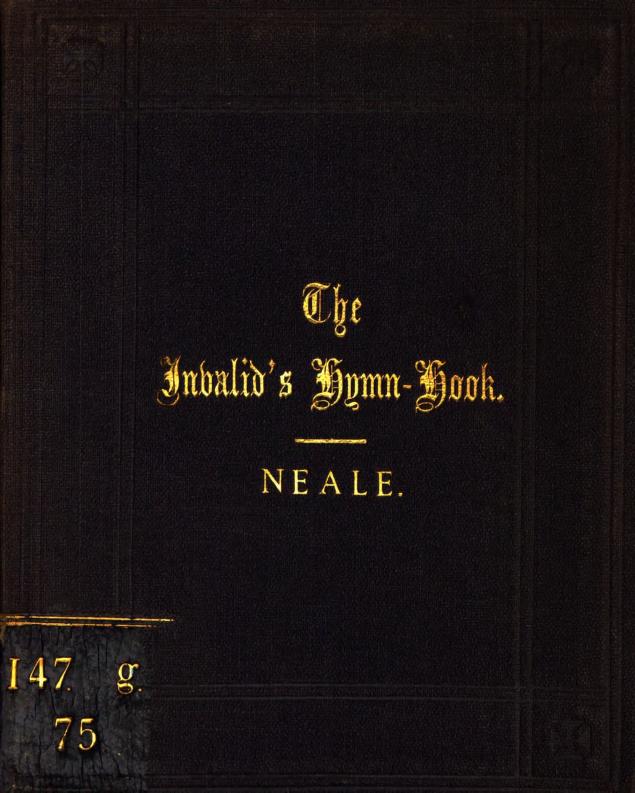
The Invalid’s Hymn Book was the first confirmed printing of “Just As I Am.” The hymn appeared anonymously, without a tune, beneath the words of John 6:37. Charlotte inherited the little collection from her dying friend Harriet Kiernan in 1834 and built it into a book of 112 of her own hymns, written for Christians too sick to attend church. About 18,000 copies had sold by 1873.
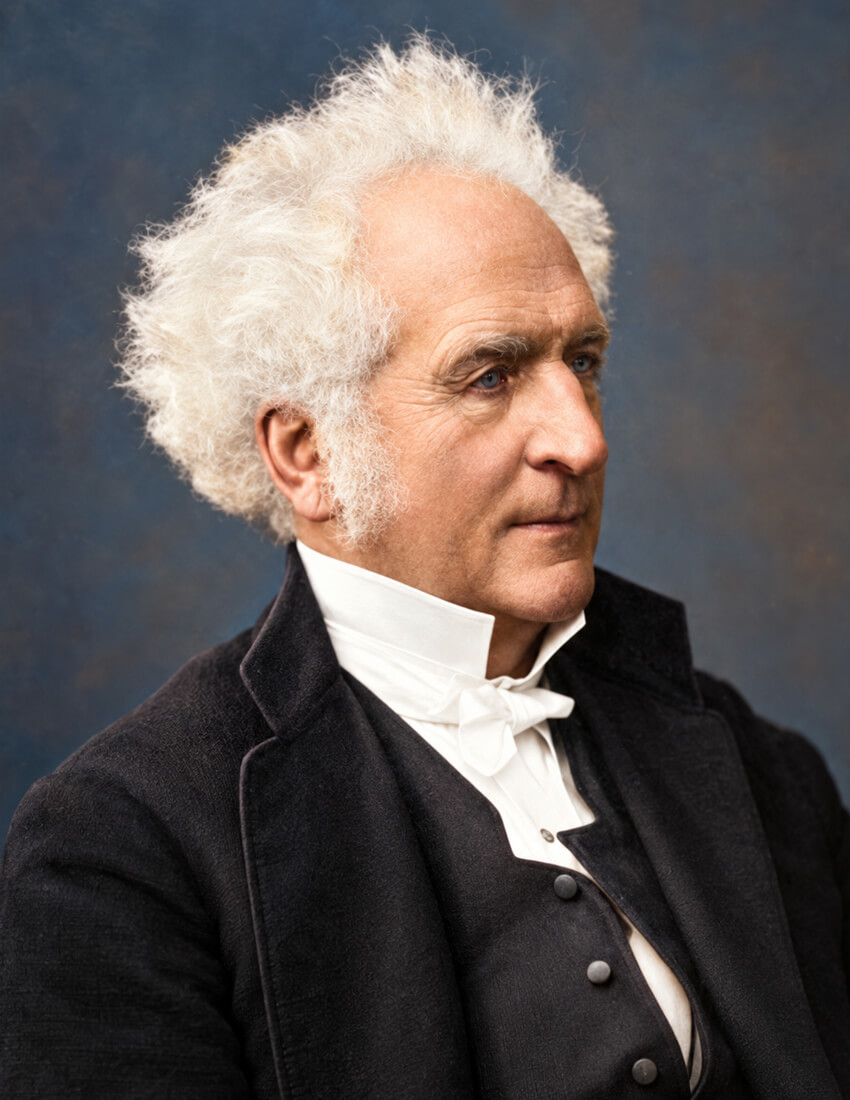
Henri Abraham César Malan (1787 to 1864) was a Geneva minister, schoolteacher, and hymnwriter, one of the leading figures of the Swiss evangelical awakening known as the Réveil. He was dismissed from his teaching post for preaching salvation by grace alone and spent the rest of his life traveling, writing, and composing hymns in French. He met Charlotte Elliott at Grove House on May 9, 1822, and the two exchanged letters for the next forty years. The familiar story of Malan telling Charlotte to come to Jesus “just as you are” first appeared in print in 1883 and cannot be confirmed, but his 1822 letter urging her to “cut the cable” survives in her family’s papers.
Charlotte Elliott, an English poet who spent most of her adult life as an invalid, wrote “Just As I Am” in 1836. According to a family account, she wrote it during a sleepless night when illness kept her from helping with a charity bazaar and she felt useless to God. The hymn was her answer to her own doubt: a plain statement that she came to Christ with no merit of her own.
The hymn was most likely written in 1836, according to two hymn historians who published during Charlotte Elliott’s lifetime. Its first confirmed appearance in print was the 1841 Dublin edition of The Invalid’s Hymn Book. The tune most Americans know, WOODWORTH by William Bradbury, was not paired with the text until 1860.
Charlotte Elliott was an evangelical Anglican. She was born into the Clapham Sect, the circle of Church of England reformers that included William Wilberforce, and her grandfather Henry Venn was a leading minister of the eighteenth-century revival. Two of her brothers were Anglican clergymen. Illness kept her from public worship for much of her life, and she once said, “My Bible is my Church.”
“Just As I Am” expresses the Christian belief that God accepts us on the basis of Christ’s sacrifice alone, not our own merit or readiness. The singer comes to Christ without any defense or excuse (“without one plea”), trusting entirely in His mercy. Though it is best known today as an invitation hymn, it was first published in a book for sick Christians and was originally sung as a prayer of continuing dependence and at Holy Communion.
There is a particular kind of discouragement that comes from feeling useless. Not the sting of failure, but the quieter ache of watching others do the work you long to do while you sit on the sidelines. “Just As I Am” was written by a woman who knew that ache better than most, for she spent fifty years of her life confined to a sickroom. She wrote the hymn on a night when she felt she had nothing to offer God. She could not have been more wrong.
Years after the hymn was written, a physician in the English seaside town of Torquay paid a visit to one of his patients, an elderly invalid who rarely left her home. He had brought her a small printed leaflet. On it were the words of a hymn that had been circulating anonymously, and he thought it might bring her some comfort in her weakness. The patient read the leaflet and thanked him. The physician had no idea that the woman in the chair was Charlotte Elliott, and that the hymn he had just handed her was her own.
That is the story of “Just As I Am” in miniature. It left its author’s room, traveled the world without her name attached, and came back to her as a gift from a stranger. To understand how a hymn could do that, we have to go back to the beginning.
Charlotte Elliott was born at Grove House in Clapham, England, 1789. Some older reference books place her birth in Brighton, but her sister’s memoir and modern archival research agree on Clapham, then a village outside London and the center of a remarkable spiritual movement. Her father, Charles Elliott, was a prosperous silk merchant. Her mother, Eling, was the daughter of the Reverend Henry Venn, one of the leading ministers of the eighteenth-century evangelical revival. Charlotte’s uncle, John Venn, was rector of Clapham and a close associate of William Wilberforce and the reformers known as the Clapham Sect. Missionary societies, Bible distribution, and the fight against slavery were dinner-table conversation in the Elliott home.
One might expect such a household to produce a solemn child. It did not. Young Charlotte was known for her wit. She wrote humorous verse for family and friends, drew portraits, and sang in the family choir with what her sister called an unusually fine ear. She moved comfortably in cultured circles that included writers and thinkers who did not share her family’s faith. Poet, artist, musician; Charlotte had gifts enough for several careers, and every one of them seemed to point toward a lively and public life.
It seemed her path was set. But the following years showed her otherwise.
In 1821, at the age of 32, Charlotte was struck with a severe illness. No diagnosis survives, and her own letters describe only the symptoms: weakness, pain, exhaustion, dizziness, and long stretches when she could not leave her bed. The active social life she had enjoyed came to an end. She would remain an invalid for the rest of her days.
Physical sickness soon revealed a sickness of the soul. Charlotte had felt drawn to Christ since childhood, but now she began to question whether she could be saved at all. She examined her feelings over and over, searching for some proof that she was a true believer, and the search only left her more uncertain. This was her condition in the spring of 1822, when a visitor from Switzerland came to Grove House.
The visitor was César Malan, a Geneva minister and hymnwriter connected to the Swiss revival known as the Réveil. He met Charlotte on May 9, 1822. What passed between them that day was not recorded in detail, but its effect was permanent. Malan urged her to stop relying on the quality of her feelings and to place her confidence directly in Christ. For the rest of Charlotte’s life, the Elliott family kept May 9 as the birthday of her soul.
Nine days later, Malan wrote her a letter that said what he had been trying to say in person:
“Dear Charlotte, cut the cable, it will take too long to unloose it; cut it, it is a small loss; the wind blows and the ocean is before you – the Spirit of God and eternity.”
You may have heard a fuller version of this story, one in which Malan asks Charlotte whether she is a Christian, she answers sharply, and days later he tells her to come to Jesus “just as you are.” It is a beautiful account, and it appears in hymn books everywhere. It also first appeared in print in 1883, sixty years after the meeting, and no trace of it exists in Charlotte’s letters, her journals, her sister’s memoir, or her obituary. The true story is less dramatic. Malan and Charlotte corresponded for forty years, and the conviction he planted in 1822 would take fourteen years to flower into a hymn.
Charlotte’s health improved briefly in the 1820s and then collapsed. By 1829 she was too weak to leave her room without help; she had to be carried downstairs and lifted into a carriage. Her father died in 1832. In a letter written the following year, she admitted that accepting both his death and her own continued suffering had cost her “many bitter tears” and “hard struggles.” Resignation did not come easily to Charlotte Elliott. It was fought for.
In 1834 she found her life’s work. A friend named Harriet Kiernan, who was dying of consumption, edited a small yearly devotional called The Christian Remembrancer Pocket-Book. Before her death, Kiernan handed the little book to Charlotte, along with an unfinished collection of hymns for people too sick to attend church. Charlotte took up both. She edited the Pocket-Book for the next twenty-five years, choosing a Scripture text for every day of the year and giving every penny of the proceeds to a charity in Dublin. The family called her hunt through the Bible for suitable verses her “gold diggings.” The hymn collection, meanwhile, grew into The Invalid’s Hymn Book, and it would eventually hold 112 of her own hymns.
None of this was easy. Concentrated work brought on dizziness and spasms of pain, and she cut back her ordinary letter writing so that what strength she had could go to the hymns. In that same 1833 letter to her sister Eleanor, she described the daily battle in her own words:
“He knows, and He alone, what it is, day after day, hour after hour, to fight against bodily feelings of almost overpowering weakness and languor and exhaustion; to resolve, as He enables me to do, not to yield to the slothfulness and the self-indulgence, the depression, the irritability such a body causes me to long to indulge, but to rise every morning, determined on taking this for my motto: ‘If any man will come after me, let him deny himself, take up his cross daily, and follow me.’”
The hymn was written in 1836. The exact day is lost, but two hymn historians who published during Charlotte’s lifetime, one of whom corresponded with her, both gave that year.
The story of how it came to be was told by Bishop Handley Moule in 1897, who said he had it from the Elliott family. Charlotte’s brother Henry, a minister in Brighton, had founded St. Mary’s Hall, a school for the daughters of poor clergymen. The whole household was busy preparing a bazaar to raise money for it. Charlotte could do nothing to help. She spent a sleepless night feeling useless, and in the dark hours she began questioning the foundations of her faith all over again. What she did next was to write down, in a few plain lines, what she still believed. A sister-in-law found the verses and copied them out. The rest of the world would call them “Just As I Am.”
That is the family’s account, first published six decades after the fact, and the details cannot be verified. But the heart of it rings true to everything else we know of Charlotte Elliott: a woman who felt she had nothing to offer, answering her own doubt with the gospel.
Just as I am, without one plea,
But that Thy blood was shed for me,
And that Thou bidd’st me come to Thee,
O Lamb of God, I come, I come!Just as I am, and waiting not
To rid my soul of one dark blot,
To Thee whose blood can cleanse each spot,
O Lamb of God, I come, I come!Just as I am, though tossed about
With many a conflict, many a doubt,
Fightings and fears within, without,
O Lamb of God, I come, I come!
The hymn first appeared in print in the enlarged 1841 edition of The Invalid’s Hymn Book, published in Dublin. It ran without her name and without a tune, and above it stood a single verse of Scripture: “Him that cometh to me I will in no wise cast out.” Six stanzas made up the original. A seventh was added in 1849.
Notice where it was published. “Just As I Am” was not written for revival tents or for seekers walking an aisle. It was written for a book of hymns for the sick, and it was written by a woman who had been a Christian for fourteen years. Its first meaning was not “come to Christ for the first time,” but “come to Christ again, today, with all your fightings and fears.” That is why The English Hymnal later filed it under Holy Communion. The altar-call hymn came later. The invalid’s hymn came first.
The earliest testimony to the hymn’s power comes from an unexpected household. In 1849, Dora Quillinan, the daughter of the poet William Wordsworth, lay dying. Her husband was given a copy of the hymn to read to her. Dora’s response was recorded in a letter written at the time: “That is the very thing for me.” She asked to hear it again and again during the two months that remained to her, and her husband wrote that William Wordsworth himself found comfort in it.
From there the hymn traveled by leaflet, by hymnal, and by word of mouth. It was translated into French, German, and Italian. It reached India, where the missionary Joseph Peet, after thirty years of service, gave his final instructions to the native pastors and then asked, “Now repeat my favourite hymn, ‘Just as I am.’” By the time Charlotte died, the hymn was being sung on both sides of the Atlantic, and American congregations knew it to a tune she had never heard.
Her brother Henry preached for decades in Brighton. According to a remark published shortly after Charlotte’s death, he once said that for all the fruit of his long ministry, far more had been done by a single hymn of his sister’s.
The 1840s brought wave after wave of loss. Henry’s wife died in 1841. Charlotte’s mother died in 1843, her sister Mary the same year, and her sister Katherine in 1846. Charlotte made a home with her youngest sister Eleanor and Eleanor’s husband, the Reverend John Babington, first in Torquay and then, from 1857, back in Brighton. Eleanor ran the household so that Charlotte could give her limited strength to the work.
Henry died in January 1865. Charlotte’s condition kept her from his bedside, a grief she found especially hard to bear. Her last journey from home came in 1867. After that she was confined to her house, and often to her chair or bed, and she could no longer attend church at all. Ministers came to her home to bring her Communion. She did not complain of the loss. “My Bible is my Church,” she said, and went on to describe how she found in its pages her confession, her thanksgiving, her praise, and a congregation of prophets, apostles, and martyrs.
In her last years she compared her hold on Christ to a limpet clinging to a rock and to an infant resting in its mother’s arms. A few days before the end, she told her sister that their next meeting would be at the marriage supper of the Lamb. When someone repeated to her the words of Jesus about an untroubled heart, she replied, “But my heart is not troubled,” and added, “My mind is full of the Bible.” On the morning of September 22, 1871, Eleanor read aloud from Isaiah: “Thine eyes shall see the King in his beauty.” Charlotte clasped her hands and raised her eyes. She died that evening at her home on Norfolk Terrace in Brighton, 82 years old, and was buried in the family vault at St. Andrew’s Church in Hove.
Charlotte Elliott never heard the tune most of us know. William Bradbury paired his melody with her words in 1860, and by the twentieth century the two were inseparable. When a young evangelist named Billy Graham began holding crusades, “Just As I Am” became the hymn his choirs sang as people came forward. He used it for more than sixty years, and when he wrote his autobiography in 1997, he gave it her title.
Most telling of all the Graham stories comes from London in 1966. Critics had accused the crusade of using music to manipulate emotions, so the team dropped the invitation hymn entirely. For thirty nights the choir stayed silent while people came forward anyway. It was the press, in the end, who asked why the familiar hymn had disappeared. The hymn was never the power: it was the plea. When Graham died in 2018, “Just As I Am” was sung as he lay in honor at the United States Capitol and played as the postlude at his funeral.
Today the hymn appears in more than 2,500 hymnals, one of the most printed English hymns ever written. It is sung at altar calls and at Communion, at funerals and in hospital rooms, by Anglicans and Baptists and Pentecostals alike.
Indeed, the woman who felt she had nothing to give on a sleepless night in 1836 gave the church one of its most useful prayers. Whatever your sickroom looks like, whatever it is that keeps you from the work you long to do, Charlotte Elliott’s hymn has one word of counsel. Come anyway.
Just as I am, of that free love
The breadth, length, depth, and height to prove,
Here for a season, then above,
O Lamb of God, I come, I come!

I have discovered an interesting secret about “Just As I Am”: it’s really a worship song in disguise!
Growing up in the Baptist church, we sang it literally every Sunday during the invitation. (For you non-Baptists, that is the end of the service when people come forward to get saved, rededicate their lives, confess sin, or join the church.) I think we all must have gotten burned out on it, because I haven’t heard “Just As I Am” in a contemporary church in years.
But look at what the hymn actually does. Praise and worship songs typically talk TO the Lord. Hymns typically talk ABOUT the Lord. “Just As I Am” is different. From the first line to the last it addresses the Lord directly, just like a worship song: Thy blood was shed for me, Thou bidd’st me come to Thee, O Lamb of God, I come. Charlotte Elliott was writing a modern worship song a hundred and fifty years before anyone knew what that was.
To help contemporary churches use this classic hymn, I arranged it in a more modern worship style that will match your favorite songs by your favorite worship artists. You can hear the arrangement in the lyric video in the sidebar.