

Don Chapman
Composer/arranger Don Chapman has created HYMNDEX as a labor of love to help new generations learn about the lives, legacies and lyrics of historic hymn writers.

Born: December 18, 1707, Epworth, Lincolnshire, England
Died: March 29, 1788, London, England
Buried: April 5, 1788, St Marylebone churchyard, London (per Westminster Abbey records)
Nationality: English
Occupations: Anglican priest, hymnwriter, poet, evangelist
Denomination: Church of England (co-founder of the Methodist movement)
Spouse: Sarah Gwynne (married 1749); eight children, three of whom survived to adulthood
Known for: Writing thousands of hymns, including “Hark! The Herald Angels Sing,” “And Can It Be,” and “O For a Thousand Tongues to Sing”
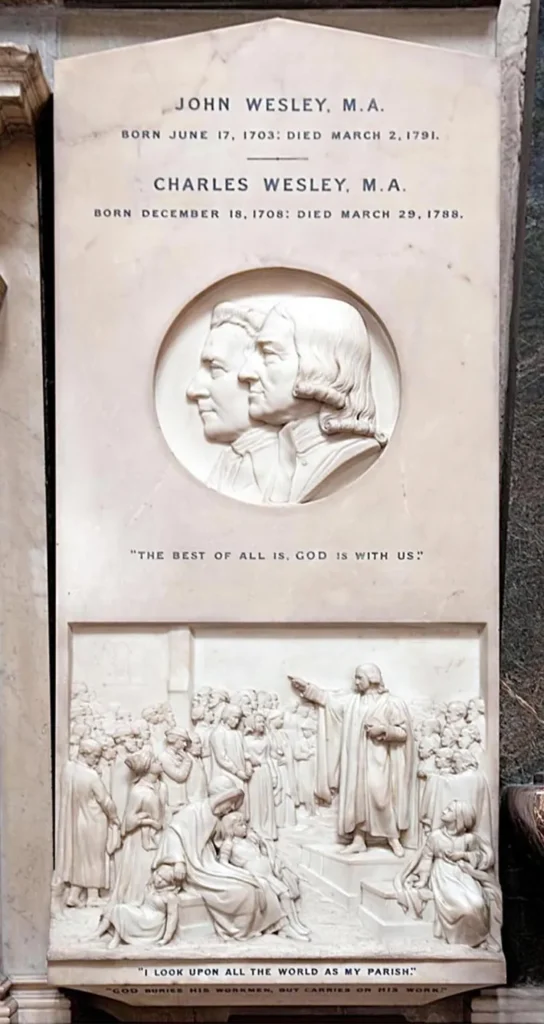
A quick note for the detail-minded: even the marble gets Wesley’s story wrong sometimes. The memorial to John and Charles in Westminster Abbey engraved Charles’ birth year as 1708, and the Abbey itself acknowledges the date should read 1707. If a national shrine can misplace a year, we can forgive the many hymnals that have done the same.
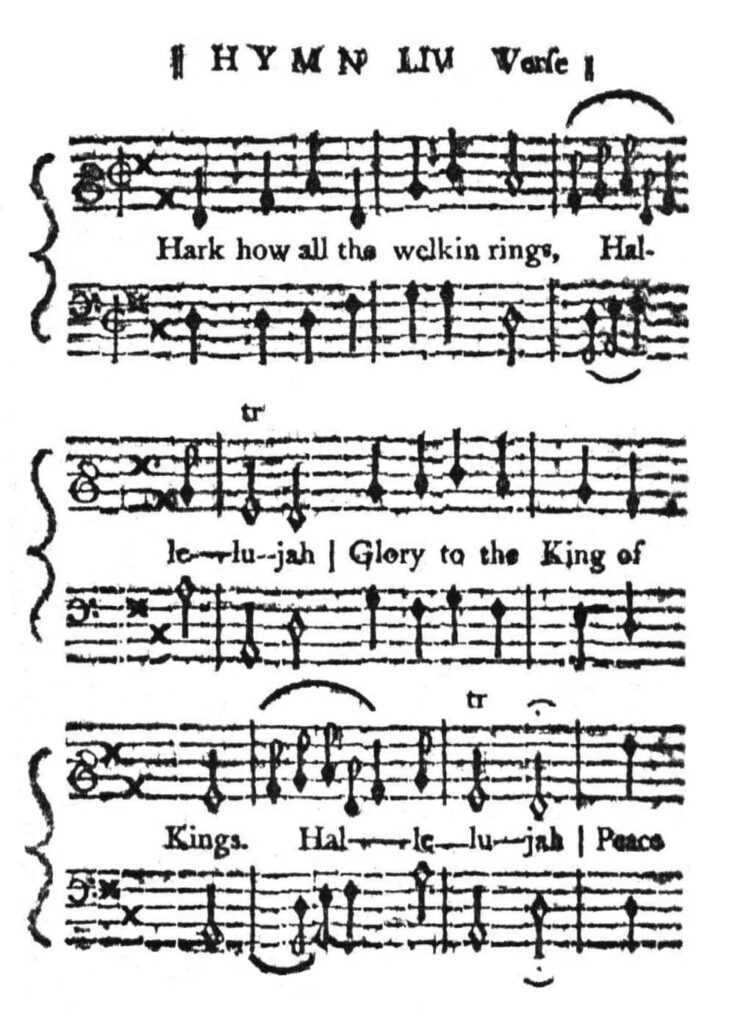
I never knew this: “Hark! The Herald Angels Sing” was not the original lyric! Wesley’s 1739 text began “Hark how all the welkin rings” (“welkin” being an old poetic word for the heavens). Perhaps Wesley got a little too fancy for the average worshiper, and in 1753 his friend George Whitefield reined him in, swapping the welkin for the herald angels we all sing today.
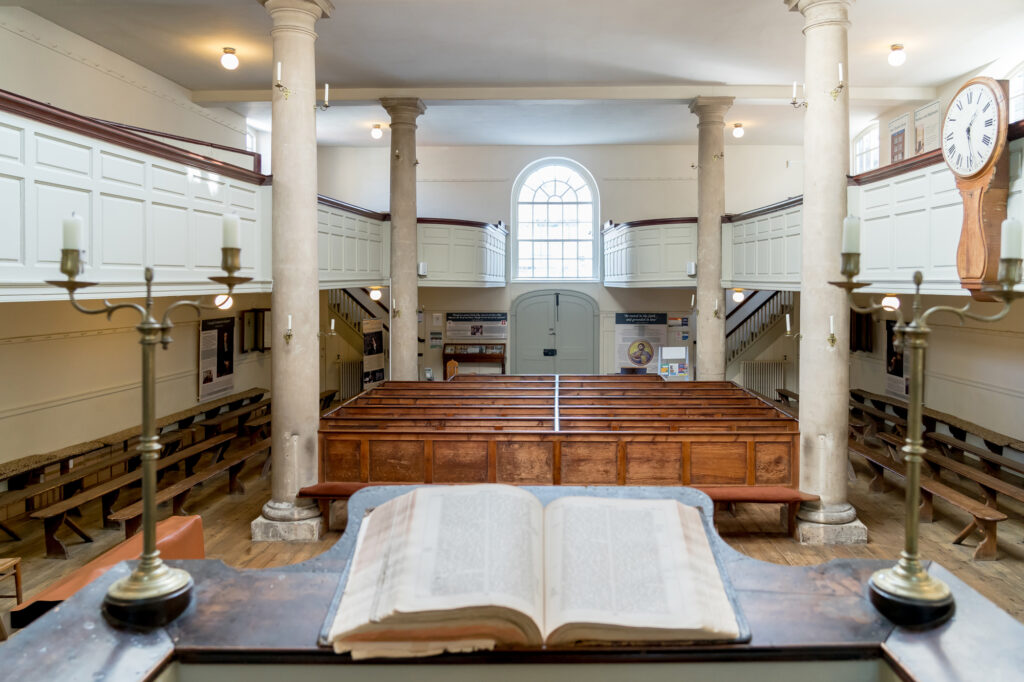
The view from the pulpit of the New Room in Bristol, the oldest Methodist building in the world. Charles Wesley preached from this very spot, looking out over these same pews. He and his family lived just a short walk away on Charles Street, and the New Room served as home base for his Bristol ministry for years.
Thousands of contemporary worship churches have sung Don Chapman’s arrangement of Christ the Lord Is Risen Today since 2002, when it debuted as one of the first 10 Hymncharts arrangements.
Imagine having the words you wrote be sung by millions of voices, in dozens of languages, echoing down through the centuries. Such is the legacy of Charles Wesley, a prolific English hymnwriter and Anglican cleric who penned thousands of hymns during his lifetime in the 1700s. Many of his works like “Hark! The Herald Angels Sing,” “Christ the Lord Is Risen Today,” and “Love Divine, All Loves Excelling” are still beloved classics sung in churches around the world today.
But Wesley was more than just a composer of singable verses. Together with his brother John, he was also one of the principal leaders of the Methodist movement that swept through England and beyond, bringing spiritual revival and reformation to the Anglican Church. Let’s explore the life, ministry, and lasting impact of this dedicated man of God.
Born in 1707 in the Anglican parsonage of Epworth, England, Charles Wesley was the 18th child of Rev. Samuel and Susanna Wesley. Talk about being born into a legacy of ministry! After attending Westminster School and Christ Church, Oxford, he followed in his father’s and brother’s footsteps and was ordained as an Anglican priest in 1735.
It was at Oxford that Charles, his brother John, and fellow student George Whitefield formed a prayer group and Bible study that others mockingly called the “Holy Club” due to their methodical and disciplined lifestyle. Little did they know this small band would launch a movement that would change the world.
Everything changed for Charles on May 21, 1738, when he had a profound evangelical conversion experience, feeling spiritually renewed and empowered to spread the gospel. Remarkably, this happened just three days before his brother John’s famous Aldersgate experience. Charles began writing hymns prolifically as a means of teaching sound doctrine, reaching the common people, and nourishing the Methodist societies that were springing up.
Finding many Anglican pulpits closed to their evangelical message, the Wesley brothers took to open-air preaching, reaching coal miners and commoners with the good news. Despite opposition and mob violence, the revival spread like wildfire throughout England. Charles traveled extensively alongside John, exercising joint leadership of the growing Methodist movement.
After marrying Sarah Gwynne in 1749, Charles made his home base first in Bristol and later in London, focusing his ministry there for the remainder of his life. The couple had eight children, though only three survived to adulthood: a grief Charles knew well and poured into his funeral hymns. While the brothers didn’t always see eye-to-eye on issues like separation from the Anglican Church, they maintained a close bond and common purpose in the gospel.
Ask three hymnologists how many hymns Charles Wesley wrote and you may get three different answers: 6,500, 9,000, even 10,000. Which is it? The honest answer is that it depends on what you count.
The most careful accounting comes from Duke Divinity School, whose scholarly collection of Wesley’s poetical works gathers nearly 4,400 distinct poems and hymns published during Charles’ lifetime that scholarly consensus traces to his pen. That is the floor, not the ceiling. Add the mountain of manuscript verse Charles never published, and estimates climb toward 9,000 poems or more. The popular figure of 6,500 hymns sits comfortably in the middle, while the 10,000 figure sweeps in variant texts, fragments, and differing definitions of what makes one hymn distinct from another.
There is also a wrinkle worth knowing: in the early collections, John and Charles deliberately published together without indicating which brother wrote which text. Scholars have spent a century untangling their work, and the consensus is that the vast majority of the original hymns in those joint collections came from Charles. As United Methodist scholarship points out, the numbers may be debated, but the verdict is not: no one in the English language has matched his output of singable, Scripture-saturated verse.
Wesley’s greatest legacy is undoubtedly the thousands of hymns he wrote that have stood the test of time, continuing to be sung around the world. Marked by strong biblical teaching, poetic beauty, and musical diversity, his hymns cover themes like the Trinity, Christ’s resurrection, sanctification, grace, and more.
Consider classics like:
Here is something many people misunderstand: Charles wrote the words, not the tunes. The melodies we now treat as inseparable from his texts were nearly all attached later, some more than a century after his death. His iconic Christmas carol “Hark! The Herald Angels Sing” is set to a soaring Mendelssohn melody that Wesley never heard, adapted from a secular cantata in 1855. But it’s really the rich meaning and sound doctrine behind the words that give them staying power.
Beyond individual hymns, Wesley also published many hymnals and collections, like Hymns on God’s Everlasting Love, Hymns on the Lord’s Supper, and Hymns on Select Passages of Scripture. These went on to form the bedrock of Methodist hymnody and enrich worship far beyond that tradition. He also produced metrical paraphrases of the Psalms that continue the heritage of Christological interpretation.
While Methodism’s founder John Wesley is often seen as the public face of the movement, one Methodist historian rightly calls Charles its “private face” and “heartbeat.” The younger Wesley poured his evangelical passion and gift of verse into igniting hearts and shaping the theology of this revival in a way that still echoes today.
The table below tells a quiet story all by itself: every one of these beloved tunes was paired with Wesley’s words after he wrote them, most after he died. The texts came first; the music caught up.
| Hymn text | First published | Common tune | Tune composer | Meter |
|---|---|---|---|---|
| And Can It Be | 1739, Hymns and Sacred Poems | SAGINA | Thomas Campbell, 1825 | 8.8.8.8.8.8 |
| Christ the Lord Is Risen Today | 1739, Hymns and Sacred Poems | EASTER HYMN | Anonymous, Lyra Davidica, 1708 | 7.7.7.7 with alleluias |
| Come, Thou Long-Expected Jesus | 1744, Hymns for the Nativity of Our Lord | HYFRYDOL | Rowland H. Prichard | 8.7.8.7 D |
| Hark! The Herald Angels Sing | 1739, Hymns and Sacred Poems | MENDELSSOHN | Felix Mendelssohn, adapted by William H. Cummings, 1855 | 7.7.7.7 D with refrain |
| Jesus, Lover of My Soul | 1740, Hymns and Sacred Poems | ABERYSTWYTH / MARTYN | Joseph Parry / Simeon B. Marsh | 7.7.7.7 D |
| O For a Thousand Tongues to Sing | 1740, Hymns and Sacred Poems | AZMON | Carl G. Gläser, arr. Lowell Mason | 8.6.8.6 (CM) |
| Rejoice, the Lord Is King | 1744 | DARWALL’S 148TH | John Darwall | 6.6.6.6.8.8 |
As a hymn arranger, I spend my working hours with these texts, and I can tell you why Wesley’s hymns refuse to die while thousands of his contemporaries’ hymns have vanished.
First, Wesley wrote in a wide variety of meters, and that variety is is perhaps why his texts keep finding new tunes. A hymn locked into one melody lives or dies with that melody. Wesley’s texts are interchangeable. “Jesus, Lover of My Soul” sings equally well to the brooding Welsh ABERYSTWYTH or the gentle American MARTYN, and congregations on both sides of the Atlantic claim it as their own.
Second, his texts take you on an theological and emotional journey. Nearly every great Wesley hymn travels from doctrine to personal response within a few stanzas. “And Can It Be” opens with a theological question, marches through the incarnation and the empty cell of Peter, and lands on a first-person verdict: “Bold I approach th’eternal throne.” That journey from head to heart is why his hymns work congregationally; the singer does not merely learn something, the singer answers something.
Third, the man was incapable of writing a stanza without Scripture in it. Scholars have counted Biblical allusions in Wesley’s verse by the dozen per hymn, which is why his texts teach even when the sermon does not.
One practical note for worship leaders: when your hymnal prints four stanzas of a Wesley hymn, it is almost always an abridgment. “Hark! The Herald Angels Sing” began as ten four-line stanzas opening with “Hark how all the welkin rings”; the version we sing is a patchwork of later edits, including George Whitefield’s famous swap to “herald angels” (see sidebar.) Knowing which stanzas were cut, and why, will occasionally hand you a forgotten verse that preaches better than anything you could write yourself.
Charles remained in London through his final decades, and his pen never rested. Even on his deathbed, the hymns kept coming; days before the end, too weak to write, he dictated his final verse to his wife Sarah, beginning “In age and feebleness extreme, who shall a helpless worm redeem?”
On his deathbed, Charles insisted, “I have lived, and I die, a member of the Church of England.” He meant it quite literally. He remained committed to Anglicanism even as the Methodist movement gathered steam toward becoming its own denomination, and he refused burial in the unconsecrated ground at his brother’s City Road chapel. Instead, according to Westminster Abbey’s records, Charles died on March 29, 1788, and was laid to rest in the churchyard of St Marylebone parish church on April 5, 1788: Church of England soil, just as he wished. A marble memorial to both brothers now stands in Westminster Abbey, bearing Charles’ own words: “God buries his workmen, but carries on his work.”
And carry on it did. His hymns breached denominational barriers; they have been embraced by Methodists, Anglicans, Presbyterians, Lutherans, Baptists, and even Catholics. His musical legacy is truly universal.
To this day, Charles Wesley is remembered as perhaps the greatest hymnwriter of all time, a reformer of worship, and a minister of the gospel in word and song. His hymns have endured for nearly 300 years and show no signs of fading away. They continue to inspire, teach, and unite Christians around the globe.
As we sing “Hark! The Herald Angels Sing” each Christmas or “Christ the Lord is Risen Today!” every Easter, we join our voices with the generations who have gone before and those still to come, all proclaiming the same ageless truths. That is the power of an anointed hymnwriter: to provide the soundtrack for our faith and to join us together in praise. All of this springing from one man’s passion to make Jesus known in every way he could. God buried His workman in 1788, but He is carrying on the work every Sunday morning, in every language, wherever His people gather to sing.