

Don Chapman
Composer/arranger Don Chapman has created HYMNDEX as a labor of love to help new generations learn about the lives, legacies and lyrics of historic hymn writers.

Born: August 18, 1856, Wilton, IA.
Died: September 15, 1932, Los Angeles, CA.
Buried: Chapel of the Pines Crematory, Los Angeles, CA.
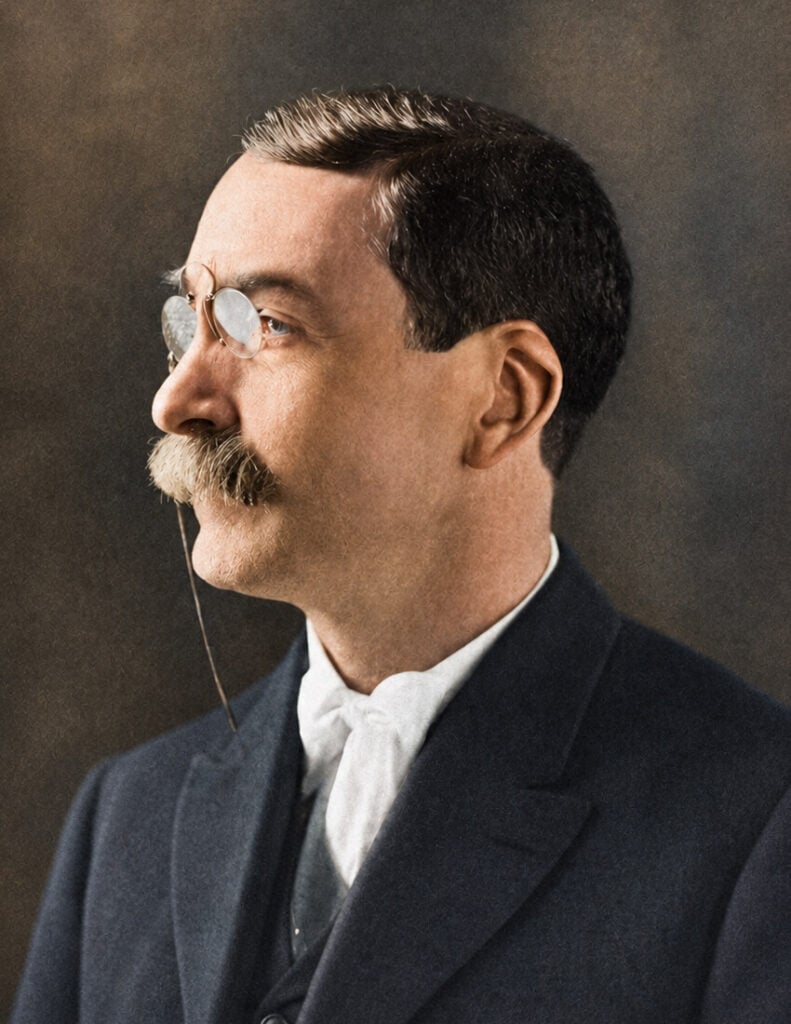
“Marvelous (I Stand Amazed)” is Don Chapman’s Hymns Reborn setting of Charles H. Gabriel’s 1905 classic “My Savior’s Love” (I Stand Amazed in the Presence). Chapman pairs Gabriel’s original lyrics with a new melody built for modern worship: contemplative verses that leap into an explosive chorus, minor chords, and a striking diminished chord on the word “wonderful.” The bridge becomes the song’s crowning glory, spotlighting the very lines that inspired Gabriel to write the hymn: “He had no tears for His own griefs, but sweat drops of blood for mine.” Download free sheet music.
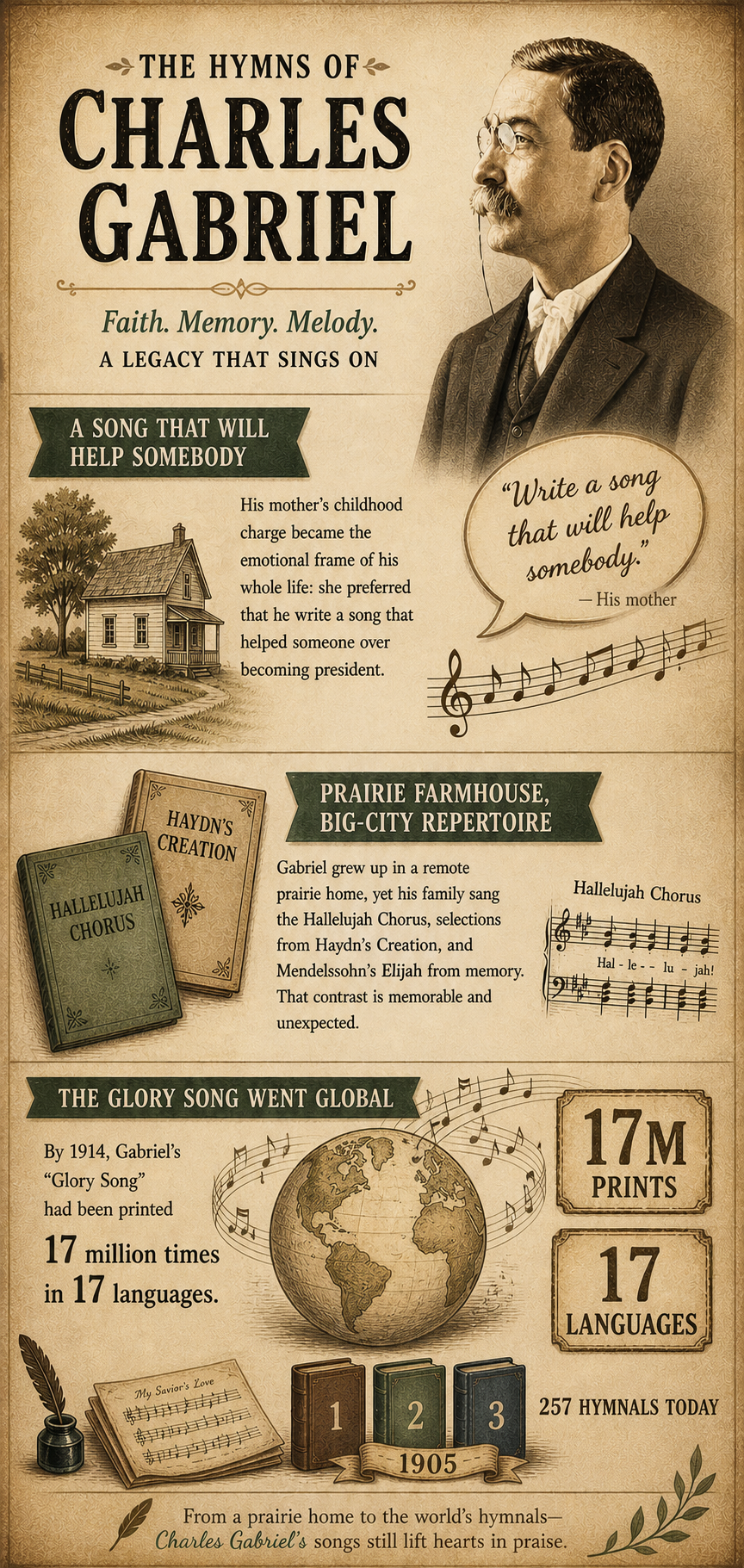
It happened when Charles Hutchinson Gabriel was a boy on the Iowa prairie. He told his mother that he wanted to write songs someday, and her reply landed with the weight of prophecy. She would rather he write “a song that will help somebody,” she said, than become president of the United States. Charles never forgot it. By the end of his life, he had written somewhere between seven and eight thousand songs, and one of them, born from two lines a friend had jotted in a letter, would carry believers straight to the garden of Gethsemane.
Charles Hutchinson Gabriel was born on August 18, 1856, on his father’s 160-acre farm seven and a half miles north of Wilton Junction, Iowa. His was the kind of childhood you might picture when you think of frontier life: a small prairie dwelling, the nearest neighbor a mile away, a schoolhouse that doubled as a Sunday school, and winters spent learning whatever lessons the local teacher could offer when farm work allowed.
His father, Isaac Newton Gabriel, was a farmer first; but he was also a neighborhood music teacher, a civic officeholder, and, in 1864, the appointed captain of an Iowa state militia unit. Most importantly for our story, Isaac led the family in song using a tuning fork, turning the Gabriel home into a kind of informal music conservatory. Family and neighbors gathered there to sing hymns, gospel songs, and even more demanding choral pieces. Charles later recalled that his family sang the Hallelujah Chorus from memory, along with selections from Haydn’s Creation and Mendelssohn’s Elijah. That is no small repertoire for a farmhouse on the prairie.
His mother, Cleopatra Cotton Gabriel (what a name!) supplied the spiritual compass. When young Charles told her of his ambition to write songs, she gave him a benchmark by which to measure his entire career: not fame, not the presidency, but usefulness to a soul. Write a song that will help somebody. Charles was one of eight children in the family, according to the Gabriel family genealogy, though some modern accounts list seven. Either way, he came up surrounded by siblings, song, and a mother’s quiet vision for his life.
Formal education was limited. There was no conservatory, no college, no academic music training in his future. Charles taught himself the reed organ, later learned piano, and absorbed everything he could from the singing-school tradition that flourished across the rural Midwest. By his teens, he was already teaching others.
On his sixteenth birthday, August 18, 1872, Charles taught his first singing school. It was a fitting birthday gift to himself, and the beginning of a vocation that would carry him across much of America. Within a few years he was conducting singing classes and institutes through the Southern, Western, and Northern states, bringing the rural music education of his own childhood to communities that needed it just as much.
Early success in publishing was another matter. Charles once supplied sixty-eight pages of words and music for a song collection that went on to sell more than 100,000 copies. His payment? Three dozen copies of the book. The discouragement nearly drove him out of music entirely. He stepped away for a time, but the pull of singing schools, conventions, and the gospel song eventually drew him back.
In the late 1880s, Charles moved to California, settling in San Francisco and serving as Sunday school music director at Grace Methodist Church. It was there that a Sunday school superintendent approached him with a practical request: the church needed a missionary song for an upcoming missionary-day offering. Could Charles write something? He could. The result was “Send the Light,” his first major sacred-song success and the song that quietly announced to the world that a new gospel composer had arrived.
In September 1892, Charles arrived in Chicago with a sick wife, an infant son, and sixteen dollars to his name. It was hardly the auspicious entrance one might hope for, but Chicago was where God meant for him to be. He soon connected with Dr. J. F. Berry, who engaged him for an Epworth League songbook, and during that period composed the tune for “Higher Ground.” His payment for that tune was five dollars. The years ahead would be very different. Charles became a central figure in gospel-song publishing, eventually editing and composing for Homer Rodeheaver, Hope Publishing, and E. O. Excell, names that defined an entire era of American hymnody.
By 1905, Charles was a working professional in the heart of the gospel-song industry. That was the year a letter arrived from Elijah P. Brown, founder of The Ram’s Horn magazine. Brown had jotted down two lines, a small fragment of an idea about Christ in the garden, and he sent them to Charles with a simple suggestion: the theme might make a good song. Charles read the lines, agreed that it might, and sat down to write.
The hymn that emerged was originally titled “My Savior’s Love,” though most of us know it today by its opening line: “I stand amazed in the presence of Jesus the Nazarene.” Brown’s two lines were not discarded; they became part of the second stanza, nearly word for word:
For me it was in the garden He prayed: “Not My will, but Thine.”
He had no tears for His own griefs, but sweat-drops of blood for mine.
That stanza alone tells you what kind of hymn this is. It does not stay in safe theological abstraction; it walks straight into Gethsemane and stands beside the kneeling Christ. The Biblical center of the song is the agony in the garden and the cross that followed, drawing especially from Luke 22:43-44, where Luke describes the angel strengthening Jesus and the sweat that fell like drops of blood. The third stanza picks up that angelic-comfort moment, and the final stanza looks ahead to Revelation 22:4, when believers will see Christ’s face and sing of His love forever.
The hymn was first published in 1905 in three different collections at once: E. O. Excell’s Praises in Chicago, J. Wilbur Chapman and O. F. Pugh’s Songs of Praise Number Two in Philadelphia, and Daniel B. Towner and Charles M. Alexander’s Revival Hymns, also out of Chicago. To appear in three major songbooks in a single year is a strong indicator of how well-connected Charles had become, and how quickly the song was recognized as something special.
Five years later, in 1910, Charles added a new stanza beginning “He took my sins and my sorrows, He made them His very own.” It slipped into the song as the fourth stanza when Charles M. Alexander purchased the copyright and republished the hymn in Alexander’s Gospel Songs No. 2. Modern hymnals often quietly drop the original third stanza, so the version most congregations sing today is not quite the version Charles first set down in 1905. But the heart of it, the wonder of a Savior’s love that took its singer all the way to a garden and a cross, has never changed.
The tune, fittingly named MY SAVIOR’S LOVE, was Charles’s own. He built it on a simple harmonic structure, kept the verse melody restrained, and let it rise more freely in the refrain. It is the kind of melody you can teach a Sunday school in fifteen minutes and remember for fifty years; which, of course, is exactly what gospel song was designed to do.
“My Savior’s Love” was hardly Charles’s only enduring hymn. He composed the tune for “His Eye Is on the Sparrow,” set to Civilla Martin’s text, which became one of the most beloved gospel solos of the twentieth century. He wrote the melody for “Higher Ground” with Johnson Oatman Jr.’s words, the tune for “Since Jesus Came Into My Heart” for Rufus McDaniel, “Brighten the Corner Where You Are” with Ina Duley Ogdon, and “Will the Circle Be Unbroken?” for Ada R. Habershon’s text. Each of those names you may recognize; behind each of them, somewhere in the credits, sits Charles Gabriel.
His “Glory Song,” with the opening line “O that will be glory for me,” became a phenomenon. By 1914, J. H. Hall reported that it had been printed at least 17 million times in seventeen languages. Charles himself, looking back near the end of his life, claimed the song had circulated in more than a score of languages and over 100 million copies. That figure is his own retrospective accounting and should be taken with a measure of grace, but even a fraction of it tells the story of an extraordinary reach.
Estimates of his total output range from about 7,000 to 8,000 compositions: hymns, gospel songs, anthems, children’s cantatas, Christmas cantatas, secular operettas, instructional books for piano and reed organ, and on and on. His songs spread far beyond the page through the urban crusades of Billy Sunday and Homer Rodeheaver, who led massive choirs and audiences in singing them. Rodeheaver himself once said that without songs like “Brighten the Corner,” he could not have held those crowds the way he did.
Charles died on September 14, 1932, in Hollywood, California, after a long illness. He left behind no recorded final words, no dramatic deathbed scene; just decades of work and a body of song that has outlived him by nearly a century. “My Savior’s Love” alone is found in 257 hymnals across denominations and languages, from Baptist to Methodist to Korean Presbyterian to Spanish-language collections.
Somewhere on the Iowa prairie, more than a hundred and fifty years ago, a mother told her son she would rather he write a song that helped somebody than become president of the United States. He took her at her word. He wrote thousands of them. And every Sunday morning, somewhere in the world, a congregation still stands amazed in the presence of Jesus the Nazarene, singing words that a man named Charles Gabriel set down on paper because his mother once asked him to.