

Don Chapman
Composer/arranger Don Chapman has created HYMNDEX as a labor of love to help new generations learn about the lives, legacies and lyrics of historic hymn writers.
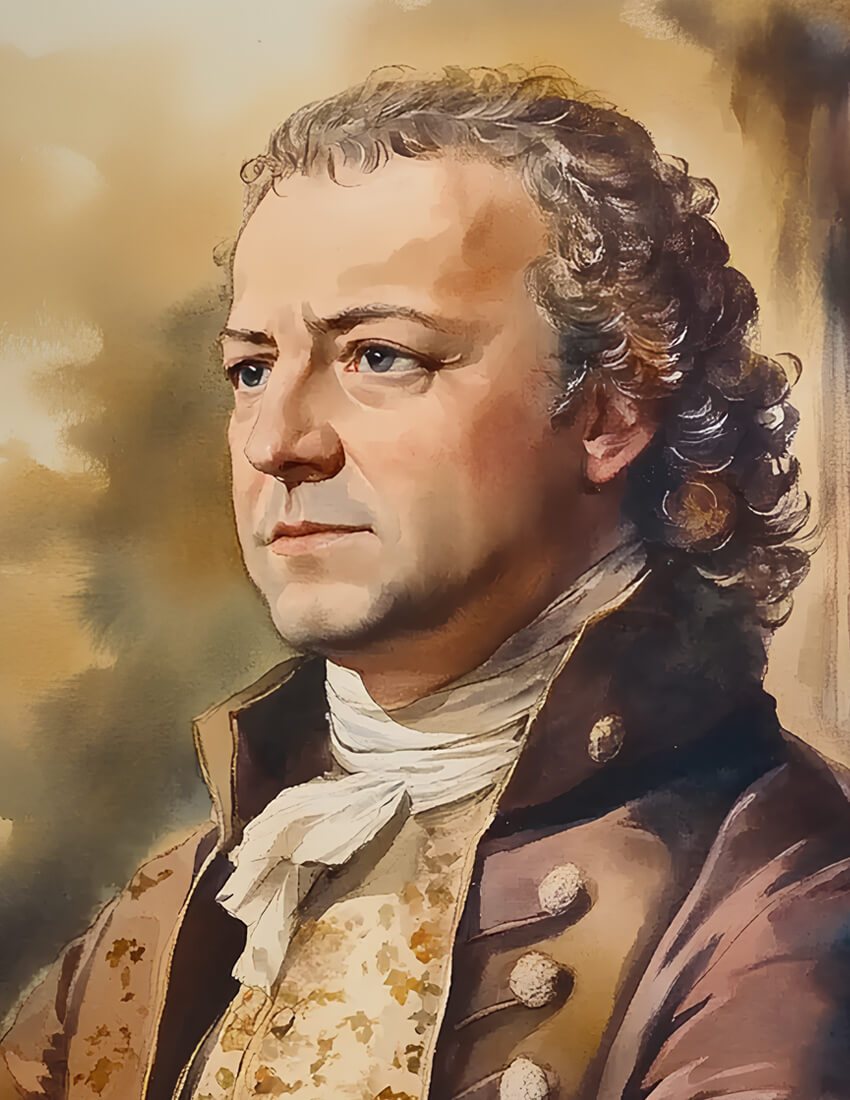
Born: September 27, 1735, Swaffham, Norfolk, England
Died: June 9, 1790, Showell Green, near Birmingham, England
Buried: Dissenters’ burial ground, Old Meeting, Birmingham
Pastor: Stone Yard (now St Andrew’s Street) Baptist Church, Cambridge, 1761 to 1790
Wife: Ellen Payne, married 1759
Children: Twelve
Best-known hymns: “Come, Thou Fount of Every Blessing” (1758), “Mighty God, While Angels Bless Thee” (1774)
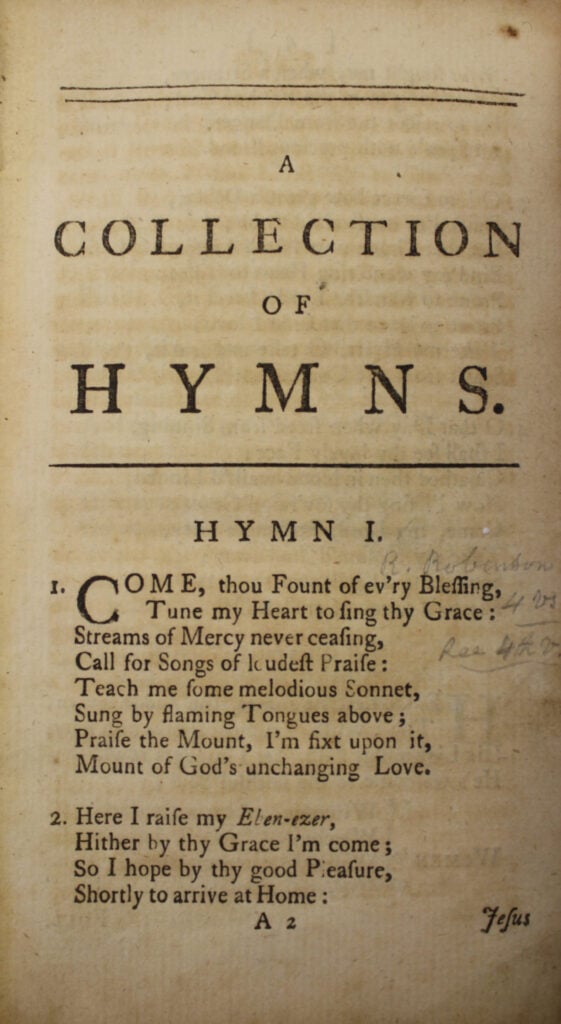
The earliest surviving printing of “Come, Thou Fount of Every Blessing” appeared anonymously in this 1759 London hymnal, A Collection of Hymns for the Use of the Church of Christ: Meeting in Angel-Alley. Robinson’s own manuscript records show that an earlier printing had been issued in Norwich in 1758, probably as a broadsheet (a single printed sheet handed out or sold separately), but no copy is known to survive. The 1759 text contains four stanzas of eight lines and was printed without music.
Every believer knows the feeling of having wandered. The wonder of the Gospel is not that we never stray, but that we are sought after when we do. “Come, Thou Fount of Every Blessing” was written by a man who understood both halves of that truth, for he confessed his wandering heart at the age of twenty-two and spent the next thirty years proving how honest that confession was.
Robert Robinson was born in Swaffham, Norfolk, England, 1735. His father, Michael Robinson, was an excise officer of Scottish background. His mother, Mary Wilkin, came from a family of some means in Mildenhall, Suffolk, but her father disapproved of the marriage and withheld the help she had expected. Michael Robinson fell into debt and left his family, and near-contemporary accounts say he died at Winchester while Robert was still a boy. So it was, Mary Robinson was left to raise three children on her own, earning what she could through needlework and by taking in lodgers, according to George Dyer’s 1796 memoir, the earliest full account of Robinson’s life.
Robert was the youngest of the three. He attended a grammar school in Swaffham and then the endowed school at Scarning, where the master, Reverend Joseph Brett, recognized an unusual mind. When Mary Robinson could no longer pay the fees, Brett kept teaching the boy for nothing. Robert gained a strong grounding in the classics, picked up French from a French usher who lodged in his mother’s home, and displayed a memory that astonished those who knew him. His mother hoped he might one day enter the ministry of the Church of England. Poverty had other plans, and his schooling ended before any thought of university.
On March 7, 1749, at about thirteen years of age, Robert was apprenticed to Joseph Anderson, a barber and hairdresser in Crutched Friars, London. It was honest work, but it was not the work of a boy who loved books. Anderson discouraged any reading that interfered with the business, and even objected to the cost of candles. Robert answered by rising at three or four in the morning to study before the household was awake. His fellow apprentices took notice, and one of them later remembered the matter simply: “we all loved Robert.”
The city was altogether a hard place for a fatherless boy, and the early biographies say he fell in with rough company. That company was about to lead him somewhere none of them intended.
On May 24, 1752, Robert Robinson went to hear George Whitefield preach. The tradition, recorded by Dyer and repeated ever since, says he and his companions had spent the day making a fortune-teller drunk and came to the sermon to mock. No eyewitness left a record of the prank, so it should be held loosely. What is documented is the text. Whitefield preached from Matthew 3:7 on the “wrath to come,” and the sixteen-year-old barber’s apprentice walked away shaken, as this Desiring God study of Robinson carefully traces.
Conversion did not come that night. It came slowly, over more than three years of searching. Robert kept a private chronological record, and in it he marked December 10, 1755, as the day he “found full and free forgiveness through the precious blood of Jesus Christ.” Those words are the clearest thing he ever wrote about his own salvation. Keep them in mind, for they will surface again in his most famous hymn.
Anderson released him from his indentures, and Robert set about preparing to preach. He didn’t rush to a pulpit. Instead he withdrew to lonely places and preached aloud to no one, sometimes for an hour at a time, testing whether he could do it at all. His diary shows a young man wary of his own ambition: “God forbid, that I should run, before I am sent.”
Robert Robinson began preaching publicly in 1758, first around Mildenhall and then in Norwich, where he worked for a time alongside the evangelist James Wheatley before gathering a small Calvinistic congregation of his own. He was twenty-two years old, three years past his conversion, and already writing hymns. Eleven of his anonymous texts had appeared the year before in Whitefield’s Hymns for the Fast-Day, published for the national fast of February 1, 1757, as the Dictionary of National Biography notes.
Then came the hymn that outlived all the rest. Robinson’s own catalog of his publications lists a hymn beginning “Come, Thou Fount of Every Blessing” as printed by Wheatley in Norwich in 1758. No copy of that printing survives. The earliest text we have appeared anonymously the following year in A Collection of Hymns for the Use of the Church of Christ, Meeting in Angel-Alley, Bishopsgate, London, 1759, in four eight-line stanzas and without music. The Hymnology Archive’s study of the text lays out this publication history in detail.
Many later writers say the hymn was written for Pentecost Sunday of 1758. It is a lovely idea, and later hymnals did file the text under Whitsuntide, but no document from 1758 says so. Robinson never explained where or why he wrote it. What he left instead was the hymn itself, and the hymn tells his story plainly enough:
Jesus sought me when a stranger,
Wandering from the fold of God;
He, to rescue me from danger,
Interposed His precious blood.
The barber’s apprentice who wrote “the precious blood of Jesus Christ” in his diary in 1755 wrote “His precious blood” into a hymn in 1758. That isn’t coincidence, that’s a man setting his own testimony to meter.
Of all the lines in the hymn, one has puzzled more singers than any other:
Here I raise my Ebenezer;
Hither by Thy help I’m come.
The word comes straight from 1 Samuel 7:12. After God delivered Israel from the Philistines, Samuel set up a stone and named it Ebenezer, meaning “stone of help,” saying, “Thus far the Lord has helped us.” Robinson was not being obscure; he was doing what eighteenth-century congregations expected, reaching for a Bible story every listener would recognize. The stone is a memorial of God’s past help and a promise about His future help, which is exactly what the second stanza goes on to say. Many modern hymnals have replaced the line, and something is lost when they do!
The hymn’s other images are just as Biblical. The fountain of every blessing echoes James 1:17, where every good gift comes down from above. The wandering stranger comes from the lost sheep of Luke 15. And the original fourth stanza, which most hymnals now omit, looks toward Revelation 7 and the saints in blood-washed robes:
O that day when freed from sinning,
I shall see Thy lovely face;
Clothed then in blood-washed linen,
How I’ll sing Thy sovereign grace.
Early in 1759, Robert Robinson received believer’s baptism from a Baptist minister named Dunkhorn of Great Ellingham, and with that his denominational wandering ended. The Baptist writer Anne Dutton had heard of his preaching and recommended him to a struggling congregation meeting in Stone Yard, Cambridge, a room converted from a stable that had housed Baptist worship since 1721. He preached his first sermon there on July 8, 1759. That same year he married Ellen Payne, whom he had met in Norwich.
The Cambridge church was small, perhaps thirty-four members, and Robinson served two years as a supply preacher before he would commit. Before accepting the call on May 28, 1761, he persuaded the church to adopt open communion, welcoming any sincere Christian to the Lord’s Table whether or not they had been baptized as believers. It was a conviction he would defend in print for the rest of his life. He was ordained on June 11, 1761, and never served another church, as the history of St Andrew’s Street Baptist Church records.
Under Robinson the congregation outgrew its stable. A new chapel seating six hundred opened on August 12, 1764. He preached two or three times each Sunday without a manuscript, held early services for working people, and kept up village preaching stations across the countryside, as many as fifteen by later count, with crowds numbering in the hundreds. Preacher, catechist, trainer of young ministers; Robinson filled every role a growing church required. Some older members grumbled when he introduced tunes they thought too “sprightly,” which tells us that the man who wrote “tune my heart to sing Thy grace” cared a great deal about how his people sang. In many ways he resembles a busy, marketing-minded modern megachurch pastor!
A Baptist salary in eighteenth-century Cambridge could not feed twelve children and an aging mother. Robinson therefore did what many a Dissenting minister did: he worked. In June 1773 the family moved to Chesterton, where he farmed, traded in corn and coal, and shipped goods along the River Cam. By 1782 he owned two farms totaling about 171 acres. Around 1786 his son-in-law William Curtis took over most of the daily business, freeing Robinson for the historical research that filled his final years.
He was, by then, a scholar of real weight. Cambridge University would not admit a Dissenter, but Cambridge scholars opened their libraries to him, and the University of Edinburgh offered him an honorary Doctor of Divinity in 1780. He declined it. When an Anglican living was suggested as a path to advancement, he replied, “The man knows the worth of the dissenters.” His books argued for liberty of conscience, open communion, and the removal of religious tests from public office, and he summed up his creed in one sentence: “The right of private judgment is the very foundation of the Reformation.”
On Sunday, February 10, 1788, Robinson preached against the slave trade in Cambridge. The sermon was published as Slavery Inconsistent with the Spirit of Christianity, and he followed it a year later with An Essay on the Slave Trade. His argument was simple: no one could hold another human being as property and still claim to love his neighbor. It placed a Baptist pastor in a university town publicly on the side of abolition at the very moment the British campaign was finding its footing.
The hardest blow of Robinson’s later life fell on October 9, 1787, when his daughter Julia died after two years of decline. She was sixteen. Her father recorded her last words, borrowed from her Savior’s own: “Father, into thy hands I commit my spirit.” Within months, six members of the household sought baptism. Robinson told the story himself in his letters to the young writer Mary Hays, which survive as the most personal record we have of his final years.
Those same letters record something harder to read. Through the 1780s, Robinson’s understanding of the Trinity and the person of Christ shifted away from the formulas he had once defended. In 1776 he had published A Plea for the Divinity of Our Lord Jesus Christ. By 1789 his critics were calling him an Arian or a Socinian. He rejected both labels. “I am neither a Socinian nor an Arian,” he wrote to Mary Hays on September 16, 1789, adding, “I believe the Scriptures, the record that God hath given of his Son.” Yet his description of Jesus as a man in whom the divine fullness dwelt was not what his fellow Baptists meant by the deity of Christ.
Honesty requires saying plainly what the record shows. Robinson’s theology changed, and it changed substantially. Honesty also requires saying what the record does not show. He never renounced Christ. He never left his church. He never stopped preaching. He kept reading his Bible and kept his pulpit until the week he died. The man was more complicated than either his admirers or his critics have wanted him to be.
Every telling of Robinson’s life eventually reaches the stagecoach. A woman sharing a coach with him, the story goes, began to speak of a hymn that had blessed her, “Come, Thou Fount of Every Blessing,” not knowing its author sat across from her. Robinson is said to have answered, “Madam, I am the unhappy man who wrote that hymn many years ago, and I would give a thousand worlds, if I had them, to enjoy the feelings I had then.”
It is a moving story. It is also a late one. The earliest version yet located appears in Samuel Christophers’s Hymn-Writers and Their Hymns, published in 1866, seventy-six years after Robinson died. Christophers introduced it with the words “is said,” and gave no date, no place, no witness, and no source. The popular ending, in which the woman comforts him with his own line about streams of mercy never ceasing, is missing from that first printing and appears to be an even later addition.
None of this proves the conversation never happened. It does mean the story cannot bear the weight it is usually asked to carry. It is not evidence that Robinson abandoned Christianity, and it is not evidence of a deathbed return. What it may preserve is something quieter and more believable: a tired, grieving, aging man who missed the clean certainty of his youth. Many a faithful Christian has known that feeling. Robinson simply had the misfortune of having written it down first, in 1758, in a line that would follow him the rest of his days: “Prone to wander, Lord, I feel it.”
By 1790 his health was failing. He suffered attacks of breathlessness, and his spirits had sunk with his body. A physician allowed him to travel to Birmingham, and he left Chesterton on Wednesday, June 2, arriving slowly on the evening of Saturday the 5th. On Sunday, June 6, he preached twice, once at the New Meeting and once at the Old Meeting, both Dissenting congregations connected with Joseph Priestley. On Monday the breathing trouble returned. On Tuesday he seemed better, ate supper, and went to bed without complaint. On the morning of Wednesday, June 9, 1790, he was found dead in his bed at the home of William Russell at Showell Green. He was fifty-four.
There were no last words, for there was no one in the room. But Robinson had once said how he hoped to go: “softly, suddenly, and alone.” So he did.
Priestley preached after his death, and other Dissenting ministers followed with memorial discourses. His Cambridge congregation raised a tablet with an inscription by Robert Hall, who succeeded him in the pulpit. It called Robinson “the intrepid Champion of Liberty Civil and Religious,” a phrase the Hymnology Archive’s biography of Robinson preserves. His mother, who had lived with him for decades, survived him by three months. His wife Ellen survived him by eighteen years.
Robert Robinson never heard the tune that carries his hymn today. In his lifetime “Come, Thou Fount” was sung in England to JEWIN STREET, printed in Thomas Knibb’s Psalm Singers Help around 1765. The melody Americans know first appeared in John Wyeth’s Repository of Sacred Music, Part Second, published in Harrisburg, Pennsylvania, in 1813, twenty-three years after Robinson’s death. Wyeth called it HALLELUJAH, printed it in two parts with an added refrain, and named no composer.
By 1852 the tune had been renamed NETTLETON, and it has often been credited to the American revivalist Asahel Nettleton. There is no evidence for that. Nettleton was a preacher and a hymnal compiler, not a composer, and his own 1824 collection contained no music at all. The four-part harmonization sung in most churches took shape in a Methodist hymnal of 1878. What Robinson wrote as an English Baptist’s confession became, in America, a camp-meeting song, and it has stayed that way ever since.
The hymn’s reach can be measured. John Newton was borrowing its language in a letter of 1770 and again in his diary in 1777, while Robinson was still alive. Hymnary.org now lists it in more than 1,600 hymnals across Baptist, Presbyterian, Lutheran, Methodist, and Mennonite traditions, and it appears in nearly every major denominational hymnal published in the last twenty years. Whatever became of its author’s theology, his hymn kept singing the Gospel he had found in 1755.
Here is what I keep coming back to with “Come, Thou Fount”: the first line is a prayer for God to show up. “Come, Thou Fount of every blessing, tune my heart to sing Thy grace.” Robinson opens his hymn by asking the Lord to come and do something to the singer before the singer can do anything for the Lord. That makes it one of the finest calls to worship in the hymnal, and it is the reason I arranged it the way I did.
This top twenty hymn has been a cornerstone of Christian worship for centuries, and its lyrics are as powerful today as they were when Robinson wrote them in 1758. I last arranged it way back in 2002 and felt it was time for a modern update, which you can hear in the lyrics video on the top left of this page.
Most worship leaders start our worship sets with something upbeat, and there is nothing wrong with that. But on occasion, opening with a slower song works just as well, and this arrangement is built for it. It starts gently and builds in intensity, reaching a full crescendo by the final verse. Think of it as a spiritual warm-up for your congregation, preparing their hearts before the rest of the set arrives.
I recorded it in D major, which will make tenor worship leaders happy. For early Sunday morning services, though, consider taking it down a step to C. The lower key warms up the congregation’s voices, and yours, and makes the higher songs later in the set easier to sing.
As with all my arrangements, this one comes complete with sheet music, chord charts in every key, and high-quality multitracks. Your Hymncharts or Worshiphymns subscription allows you to make unlimited copies for your team.
Robert Robinson wrote “prone to wander” at twenty-two, when the confession was mostly theory. He lived the next three decades proving it true. He wandered in doctrine, he wandered in spirit, and by his own admission he sometimes wandered from the joy he had known as a young man. Yet the same hymn that confesses the wandering also names the cure, and Robinson never stopped singing it to his people.
So it is with all of us. We do not sing this hymn because we have stopped wandering. We sing it because we have not, and because the God who sought us when we were strangers has not stopped seeking. Robinson’s prayer is still the right one:
O to grace how great a debtor
Daily I’m constrained to be!
Let Thy goodness, like a fetter,
Bind my wandering heart to Thee.
Who wrote “Come, Thou Fount of Every Blessing”?
Robert Robinson, a twenty-two-year-old English preacher, wrote the hymn in 1758 while ministering in Norwich. The earliest surviving text was published anonymously in London in 1759. He later served nearly thirty years as pastor of the Baptist church in Cambridge.
What does “Here I raise my Ebenezer” mean?
The line refers to 1 Samuel 7:12, where Samuel set up a memorial stone after God delivered Israel from the Philistines and named it Ebenezer, meaning “stone of help.” In the hymn it is a marker of God’s faithfulness so far and a pledge of trust for the road ahead.
Did Robert Robinson lose his faith?
Robinson’s theology changed significantly in the 1780s, and he moved away from traditional Trinitarian language, though he rejected the labels Arian and Socinian. He never renounced Christ, remained pastor of his Baptist church, and was still preaching the week he died in 1790. The famous stagecoach story first appeared in print in 1866 and cannot be verified.
Who composed the tune NETTLETON?
No one knows. The tune first appeared without a composer’s name in John Wyeth’s Repository of Sacred Music, Part Second in 1813, under the title HALLELUJAH. The later attribution to revivalist Asahel Nettleton has no documentary support.
Hymn: “Come, Thou Fount of Every Blessing”
Written: 1758, Norwich, England
First surviving publication: 1759, Angel-Alley collection, London
Original length: Four eight-line stanzas
Key scripture: 1 Samuel 7:12, Luke 15, James 1:17, Revelation 7:14
Tunes: JEWIN STREET (c. 1765), NETTLETON (1813, as HALLELUJAH)
Hymnal appearances: More than 1,600