

Don Chapman
Composer/arranger Don Chapman has created HYMNDEX as a labor of love to help new generations learn about the lives, legacies and lyrics of historic hymn writers.

Born: October 7, 1810, 25 Alfred Place, Bedford Row, London, England.
Died: January 12, 1871, Canterbury, Kent, England. At his own direction, his tomb was inscribed: Deversorium viatoris Hierosolymam proficiscentis (“The inn of a traveler on his way to Jerusalem”).
Buried: St. Martin’s Churchyard, Canterbury, Kent, England.
Alford specifically called the grave an “inn” because he viewed death as a temporary stopping place on the journey to the heavenly Jerusalem.
Almost everything we know about Henry Alford’s inner life comes from a journal he began at his confirmation in 1826 and kept for forty-four years. Late in life he decided to destroy it. Fanny talked him out of it. After his death she spent two years editing those journals and his letters into Life, Journal and Letters of Henry Alford, D.D., published in 1873. Without her, the four-year-old at Torbay, the engagement at Heale House, the words “Our dearest boy is safe,” and Henry’s final “Thank you, darling” would all have gone into the fire. Fanny was his cousin, his wife, his critic, and his traveling companion. She was also, it turns out, his biographer and the reason this article exists.
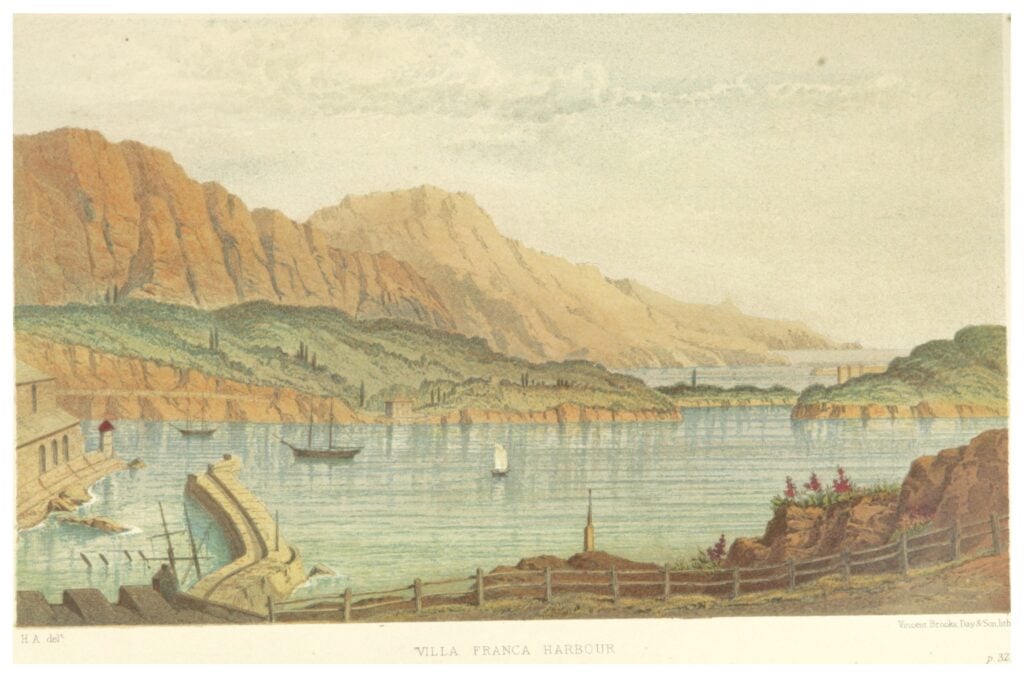
Alford was an accomplished amateur artist and illustrated his own 1870 travel book, “The Riviera”. Here is his painting of the harbor at Villefranche-sur-Mer on the French Riviera, identified in his book as “Villa Franca Harbour.”
In the summer of 1815, a family from Somerset made its way to the coast at Torbay to see a ship anchored in the bay. Aboard HMS Bellerophon was Napoleon Bonaparte, defeated at Waterloo and waiting to learn where the British would send him. Crowds lined the shore for a glimpse of the man who had reshaped Europe. Among them stood a four-year-old boy named Henry Alford. He would remember that day for the rest of his life, and it set a pattern. Henry Alford spent his sixty years standing close to great events: the birth of modern poetry at Cambridge, the upheaval of the Victorian church, the revival of harvest thanksgiving in England, and the reinvention of how the English-speaking world reads its New Testament. He watched all of it from close range, and in one quiet corner of the story, he added a song of his own.
Henry Alford was born in London, October 7, 1810, at 25 Alfred Place near Bedford Row. Older reference books give October 10, but Henry’s own dated memorandum and his widow’s biography both say October 7, and a man generally knows his own birthday. His father, also named Henry, was a London lawyer from a long line of Somerset clergy. His mother, Sarah Eliza Paget, came from a banking family in Tamworth and was remembered as a woman of intelligence and musical gifts. She never recovered her health after the birth, and she died on February 4, 1811, when her son was four months old. Some accounts say she died in childbirth. She did not, but the result for the infant was much the same: he would grow up without her.
Grief redirected the elder Henry’s life. He gave up the law, was ordained in 1813, and spent the rest of his years as a parish minister. The boy went first to his mother’s family at Tamworth, then at about two and a half years old to Heale House near Curry Rivel in Somerset, the home of his father’s relatives. Heale House became the anchor of Henry’s childhood, and, as he could not have known, the place where he would one day find his wife.
The family remembered a delicate, sensitive, and unusually imaginative child. A gardener’s scythe once cut clean through his shoe and missed his foot. Before the age of six he had produced a small illustrated book on the travels of the apostle Paul. By eight and nine he was writing Latin odes and had filled roughly fifty pages with a history of the Jewish people. In 1821, at ten or eleven years old, he stitched together a manuscript titled A Collection of Hymns for Sundry Occasions. Bible study, poetry, and hymn writing were already joined in him before he was old enough to understand what any of it would become.
Henry’s schooling was a patchwork. Illness interrupted it more than once: a severe fever, whooping cough, and an eye infection at Charmouth led his father to bring him home and teach him personally. He spent time under a Congregationalist minister named Jeanes, an early brush with Christians outside the Church of England that may have planted the broadness he showed toward them later. Two years at a school in Hammersmith, near London, were unhappy. Ilminster Grammar School, from 1824 to 1827, was not, for there he flourished in Greek, Latin, and English verse, and his teacher’s wife recalled a boy with a remarkable memory and a gentle disposition.
The most formative year came next. From August 1827 to October 1828, Henry lived and studied with the Rev. John Bickersteth at Acton, who not only prepared him for Cambridge but put him to work: teaching Sunday school, playing the organ, visiting the poor. Henry had already treated his confirmation in 1826 as a solemn covenant with God and had begun a private journal that year. He would keep it, with interruptions, for forty-four years. There was no lightning-strike conversion in Henry’s life. His faith grew the way a field grows, season by season.
He entered Trinity College, Cambridge, in October 1828. There he attended chapel twice a day and sat regularly under the preaching of Charles Simeon, the great Evangelical of that generation. In 1830 he was elected to the Cambridge Apostles, a small society of the university’s brightest students, and in doing so he stepped once again into the front row of history. His fellow Apostles included Alfred Tennyson, Arthur Hallam, and F.D. Maurice. Hallam died suddenly in Vienna in 1833, and the loss struck Henry deeply; the same loss would later move Tennyson to write In Memoriam. Henry took a scholarship, the Bell prize, the presidency of the Cambridge Union, his degree in 1832, and a Trinity fellowship in 1834. Then, in October 1833, the year the Oxford Movement began, he was ordained a deacon. He wrote in his journal, “I have now begun God’s work in the strictest sense.”
Frances Oke Alford, called Fanny, was Henry’s first cousin, the daughter of the Rev. Samuel Alford of Heale House. They had known each other since childhood. On June 5, 1832, at Heale House, they became engaged, and Henry’s journal records that they spent the following weeks reading Scripture together and planning what kind of home a minister’s household ought to be. They married at Curry Rivel church on March 10, 1835. On the honeymoon Henry took his bride to Tamworth so that he could stand at the grave of the mother he had never known.
Between engagement and wedding came an accident that could have ended everything. In November 1834 Henry fell twenty-four feet from a tree and dislocated his right elbow. The arm stayed visibly misshapen for the rest of his life. It did not stop him from writing, drawing, painting, or playing the organ, and it did not slow him down.
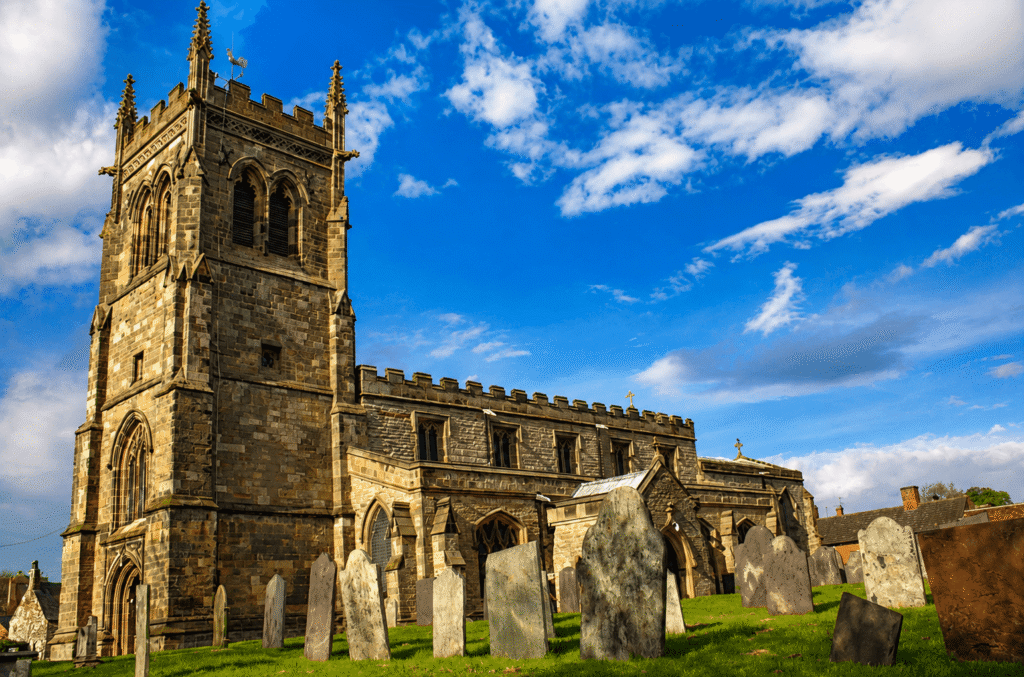
On March 4, 1835, days before the wedding, Henry was appointed to the living of Wymeswold in Leicestershire. In the Church of England of that day, a “living” was more than a job. It was a permanent post that came with a home to live in and a guaranteed income drawn from the parish, which meant a young clergyman with a living could marry, raise a family, and stay put for decades. Henry did exactly that. He would remain at Wymeswold eighteen years.
It was a large rural parish of farm laborers, tradespeople, and framework knitters, and it had been neglected. Henry set about changing that. Systematic visiting; an infant school and a National School; a new vicarage; an organ; parish hymnbooks he compiled himself; and between 1844 and 1846 a full restoration of St. Mary’s Church with the architect A.W.N. Pugin. He supported his family by tutoring some sixty private pupils over the years and delivered the Hulsean Lectures at Cambridge in 1841 and 1842. Twice he was considered for a colonial bishopric, first in connection with New Zealand and later at Fredericton in New Brunswick. He declined. Health, family, parish, and scholarship all argued for staying in England, and he listened.
Four children were born at Wymeswold. Alice came in 1836, Mary in 1838, Ambrose in 1840, and Clement in May 1843. The two daughters lived to adulthood and were both married in Canterbury Cathedral. The two sons did not.
Clement died on Easter Monday, April 8, 1844, aged eleven months, after influenza settled into his lungs. It was the first death inside Henry’s own household, and more than twenty years later he could still describe its force. In the days afterward he wrote a sentence that contains everything a Christian father can say: “Our dearest boy is safe.”
Ambrose fell ill in the summer of 1850 while the family was staying at Babbacombe near Torquay. Henry had spent the preceding days working on his Greek Testament and reading Paradise Lost aloud to the children. The illness moved fast, and on August 31 the ten-year-old died of peritonitis. Memorial windows for both boys were later placed in Wymeswold church. Henry’s journals show a faith that bent under these losses without breaking, and his understanding of heaven as a gathering place, a harvest home, took on a weight it had not carried before.
Henry’s best-known hymn belongs to Wymeswold. It first appeared in his Psalms and Hymns, adapted to Sundays and Holydays throughout the year, published in London in 1844, marked with an asterisk to show it had never been printed before. Its original heading was simply “After Harvest.” The preface is dated April 18, 1844, exactly ten days after Clement died.
That proximity is striking, and it is tempting to connect the two. The honest answer is that no one can. Neither Henry nor Fanny ever linked the hymn to Clement in any journal entry, letter, or memoir, and a hymnbook’s manuscript would have been finished well before its preface was signed. The most that can be said is that Henry wrote the hymn no later than early 1844, in a farming parish where the gathering of the crops shaped the rhythm of every year, and that he lived long enough afterward to hear his own words with a bereaved father’s ears.
What is certain is that the hymn is about far more than a good crop. It opens in the fields:
Come, ye thankful people, come,
Raise the song of harvest home:
All is safely gathered in,
Ere the winter storms begin.
Then it turns, stanza by stanza, into Christ’s parable of the wheat and the weeds from Matthew 13. The world is God’s field, good and evil grow together until the end, and the Lord of the harvest will one day separate them. The hymn that Americans sing over turkey is, at its close, a prayer for the Second Coming:
Even so, Lord, quickly come,
To Thy final harvest home;
Gather Thou Thy people in,
Free from sorrow, free from sin.
Once again Henry was standing near a turning point. In October 1843, a few months before his hymnbook appeared, the Rev. Robert Stephen Hawker held a harvest thanksgiving at Morwenstow in Cornwall that is usually credited with reviving the English harvest festival. There is no evidence Henry knew of it. Two men in two parishes were simply answering the same need at the same moment. The tune everyone now knows, ST. GEORGE’S, WINDSOR, was not Henry’s doing either. George Elvey wrote it in 1858 for a different hymn, and the editors of Hymns Ancient and Modern married it to Henry’s words in 1861. Those same editors altered his text, and in 1865 he complained that it had been “much disfigured by alterations made without the author’s consent.” He published his own revision in 1867, and that version is the one most hymnals print today.
While Wymeswold sang his hymns, Henry was building the work that would define his reputation among scholars. The first volume of The Greek Testament appeared in 1849, and the fourth and final volume around 1861. It gave English readers a critically revised Greek text with manuscript variants, grammatical notes, introductions, and commentary, all in one set.
What made it brave was where Henry looked for help. German scholars had been dissecting the New Testament for a generation, and most English Evangelicals regarded them as a danger to the faith. Henry read them anyway. He rejected conclusions that dissolved Christian revelation, but he insisted that textual and historical questions be answered with evidence rather than avoided. It cost him the trust of some conservative churchmen and earned him a lasting place among Biblical scholars. He followed it with The New Testament for English Readers in 1866, and in 1870 he was appointed to the official company revising the English New Testament, one more great event he would witness from the inside.
Henry left Wymeswold in 1853 for Quebec Chapel in Marylebone, London, where he preached to a prominent congregation, pushed them toward work among the poor, and argued publicly in 1856 that museums and the Crystal Palace should open on Sundays for working people who had no other day to visit them. An Evangelical newspaper questioned whether such a man belonged in the Church of England. In March 1857 Lord Palmerston answered by making him Dean of Canterbury.
He held the post for fourteen years, and he threw himself into the music. Scholar, preacher, editor, painter, composer, organist; Henry was all of these, and at Canterbury the musician came forward. In 1862 he founded the Canterbury Diocesan Union of Parochial Choirs, and in 1865 the Canterbury Harmonic Union, gathering village choirs and local singers for festivals in the cathedral. With the precentor Robert Hake he edited The Year of Praise in 1867, and he stated plainly what he thought a hymn should be: “plain in diction, chastened in imagery, fervent in sentiment, humble in its approach to God.” He edited the Contemporary Review, joined the Metaphysical Society, and in 1861 wrote a family masque called The Seasons in which the Dean of Canterbury played Father Christmas.
By the end of 1870 Henry was worn out. His doctor ordered rest. He went on preaching, editing, and chairing meetings for a Canterbury relief society he had helped organize for the poor during a hard winter. He preached on Sunday, January 8, 1871, with his usual energy. On Monday the pain began. By Wednesday he was drifting in and out of awareness, and on January 12 he died at the Deanery of influenza and failing lungs, aged sixty. His last clear words were to Fanny: “Thank you, darling.”
The funeral on January 17 drew the city corporation, the clergy, Nonconformist ministers, and the people of Canterbury. In the cathedral they sang his hymn “Jesus, When I Fainting Lie.” At the graveside in St. Martin’s churchyard, under a yew tree with the cathedral in view, they sang another, “Ten Thousand Times Ten Thousand.” Henry had chosen his own inscription years before: Diversorium Viatoris Hierosolymam Proficiscentis, the lodging place of a traveler on his way to Jerusalem.
The boy who watched Napoleon from the shore had grown into a man who watched a great deal else: Tennyson finding his voice, the church tearing itself in two over Rome, the railways remaking England, the Bible itself being reexamined. Yet on the day they buried him, the crowd was not singing about any of that. They were singing words he had written. Indeed, Henry Alford spent his life close to great things, and in the end the greatest of them turned out to be a hymn about gathering in.
Come to God’s own temple, come;
Raise the song of harvest home.
“Come, Ye Thankful People, Come” is the hymn that changed how Hymncharts works. Back in 2004, two years into the website, I wasn’t recording my arrangements. I assumed everyone already knew the hymns, so I just created sheet music and chord charts and figured that was enough.
I was especially proud of my arrangement of this one (hear it in the lyrics video on the left side of this page.) I gave it the tempo and feel of “Let Everything That Has Breath,” the Matt Redman song everybody was singing at the time, and I planned to roll it out the week before Thanksgiving. Rehearsal night came, I started playing, and not one person on my worship team, including the ones who’d grown up in church, knew this famous Thanksgiving hymn. I was flabbergasted! That was the moment I realized I had to start recording demos of every Hymncharts arrangement. Henry Alford wanted his hymns “plain in diction” so a congregation could actually sing them. I think he’d approve of what I do, since the melody always stays exactly as he’d know it. The feel and the chords are the only things I tinker with.