
.jpg)

Don Chapman
Composer/arranger Don Chapman has created HYMNDEX as a labor of love to help new generations learn about the lives, legacies and lyrics of historic hymn writers.

Born: November 14, 1863, Wardle, England.
Died: November 1, 1961, at her home in Seattle, Washington.
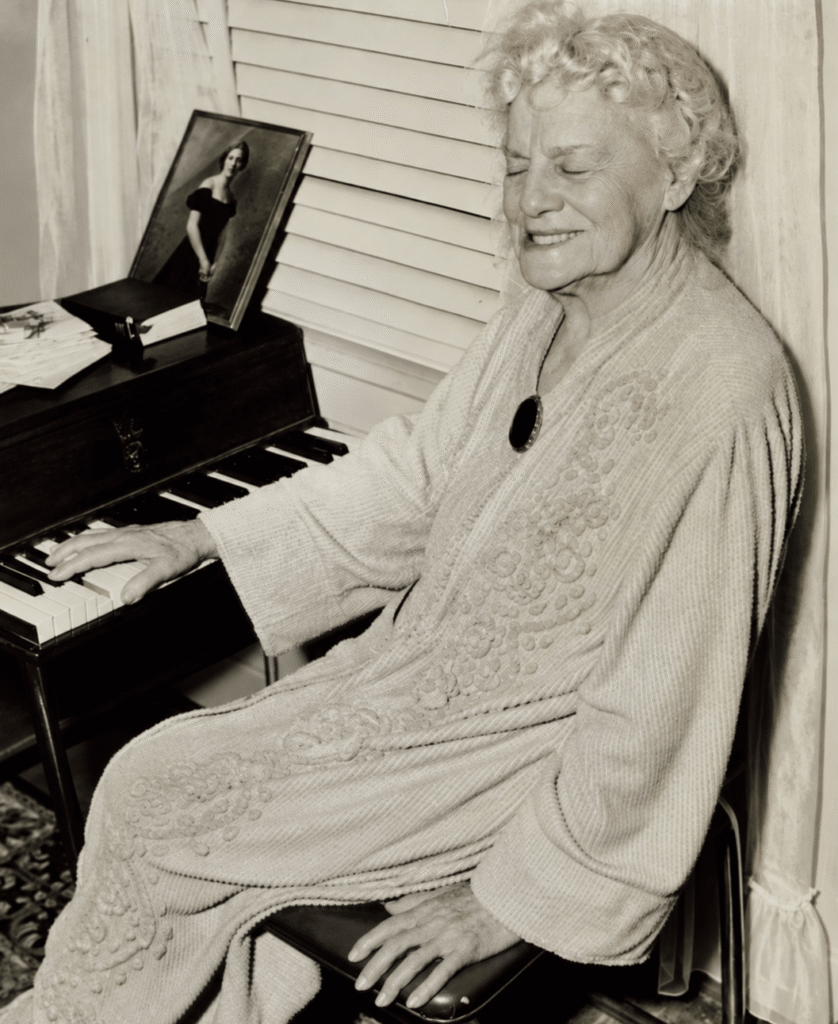
A newspaper clipping stamped November 15, 1960, offers a glimpse of Helen Lemmel’s life at 97. Though blind, she continued composing with a miniature piano, assisted by an organist who wrote down the notes. Friends celebrated her birthday with two cakes, visits, telephone calls, and a group of young women singing her hymns. “I feel well, my hearing is good and I have a good appetite,” she told the reporter.
Some people might think a person who is blind and too old to move about freely might not have much to be cheerful about.
But such persons obviously have not met Mrs. Helen Howarth Lemmel, 8232 Second Av. N. E., who was 97 yesterday.
Mrs. Lemmel, a resident of Seattle since 1904, bubbled with enthusiasm as she talked about her two birthday cakes, her 30 birthday visitors and dozens of congratulatory telephone calls.
“I feel well, my hearing is good and I have a good appetite,” Mrs. Lemmel said. Her deep Christian faith continues to be a source of strength.
Mrs. Lemmel recently completed a new hymn, one of about 500 she has written in the past 30-odd years. Many have been published. Her best-known hymn, “Turn Your Eyes Upon Jesus,” is sung in many lands.
The latest hymn is entitled, “The Eternal God Is My Refuge.”
Mrs. Lemmel uses a miniature piano in composing her music. For several years Winston Johnson, organist of the First Methodist Church, has helped her by writing down the notes as she composes.
One of the highlights of Mrs. Lemmel’s birthday celebration this year was a visit by five young girls who sang a group of her hymns.
Mrs. Lemmel was born in England, the daughter of a circuit-riding Methodist minister. The family came to America when she was 9. Advancing age took her sight.
Mrs. Lemmel has a son, Lawrence Lemmel, 73, in Arizona; seven grandchildren, and nine great-grandchildren. She resides with Mrs. Nora Eriksen.
At ninety-seven, Helen Lemmel was still finding new songs to write. Her eyesight had failed, so she composed at a miniature piano while organist Winston Johnson put her words and music on paper. A newspaper profile from November 1960, preserved with an original press photograph, reported that she had recently completed another hymn: “The Eternal God Is My Refuge.”
There is something fitting about that title. Decades earlier, Helen had written “Turn Your Eyes upon Jesus,” inviting weary believers to find their hope in the Savior. Now, with her own sight gone, she continued writing about the God in whom she took refuge.
Her famous hymn had come long before her blindness. By the time age took her sight, music had already carried her through a remarkable life.
Helen Howarth Lemmel was born on November 14, 1863, in Wardle, England, near Manchester. Her parents were Francis Howarth and Sarah Greenwood. Francis was a Methodist minister, and Helen grew up in a household where Christian faith shaped the work of everyday life.
The family eventually crossed the Atlantic and settled in America. Accounts disagree about Helen’s age when they immigrated, but Wisconsin became an important part of her early story. It was there that she married William Theophilus Lemmel on January 13, 1887. Family records identify two children, Laurance and Gladys.
Helen’s married life remains one of the less clearly documented parts of her biography. She and William later lived apart, but the available records leave the circumstances uncertain. What becomes much easier to follow is the musical work that occupied so much of her life.
Long before congregations knew her famous chorus, Helen was already writing music. Florence Sutro’s Women in Music and Law, published in 1895, records six compositions that Helen sent to an exhibition. Their titles include “Two Dandelions,” “Pansy and Dewdrop,” and “Rose, Sweet Rose.”
Those little titles offer a glimpse of a wider creative life. The woman remembered for one gospel hymn had also found subjects for music among flowers and the ordinary beauties around her. Her best-known song would grow out of years of using that musical imagination.
By 1904, Helen had made Seattle her home base. According to the biographical account preserved by Hymnary, she spent three years as music critic for the Seattle Post-Intelligencer. An interview with the celebrated singer Ernestine Schumann-Heink brought an unexpected opportunity. Schumann-Heink encouraged Helen to study in Europe, and Helen went on to spend several years studying music in Germany.
Her career included concert singing and travel on the Chautauqua circuit, which brought music and educational programs to communities across America. Writing about musicians, studying her own craft, and performing before audiences all became part of Helen’s working life.
Helen also put her experience to work in Christian education. Wheaton College’s account of her ministry records that she taught music at Moody Bible Institute and the Bible Institute of Los Angeles, now Biola University. She also directed choral groups for Billy Sunday’s evangelistic campaigns.
Children held a particularly important place in her work. The April 17, 1915, cover of Seattle’s Town Crier pictured Helen with her granddaughter, Gladys Katherine Barber. Its caption introduced her as a singer and a writer of children’s songs and stories.
One surviving example is “The Song the Shepherds Heard,” published in Victory Songs in 1920. Helen supplied both its words and music, retelling the Christmas account of the shepherds and the angels. Hymnary classifies it among the collection’s children’s songs.
That work deserves a place beside her more familiar hymn. A song learned in childhood can remain in the memory long after the lesson surrounding it has faded. Helen devoted a considerable part of her career to giving young listeners Christian truths they could carry away singing.
In 1918, Helen read a devotional booklet called Focussed. Its author, Lilias Trotter, was an English artist and missionary to Algeria. A 1954 profile in The Sunday School Times traces the hymn’s beginning to Helen’s encounter with that booklet.
Trotter’s message concerned the direction of a person’s attention. Where do our thoughts return when the demands of the day briefly loosen their grip? What holds the heart when nothing else is pressing for an answer? In Focussed, as discussed by her biographer Miriam Huffman Rockness, Trotter urged readers to turn their attention fully toward Jesus. As He occupied the center of their vision, other things would lose their claim to first place.
Helen found a song in those words.
According to the recollection preserved by Wheaton College, she described the experience this way:
“Singing in my soul and spirit was the chorus, with not one conscious moment of putting word to word.”
The refrain seemed to arrive with its own melody. During the following week, she developed the verses through her usual process of composition, while regarding the work as guided by the Holy Spirit.
It was a striking meeting of two women’s gifts. Trotter had expressed a spiritual truth in prose. Helen gave that truth words and music that a congregation could sing together. The result was the hymn she called “The Heavenly Vision.”
The song’s early publication history has gathered conflicting details over the years. One date is firmly recorded: the U.S. copyright renewal catalogue gives April 12, 1922, as its original copyright date and credits Helen with both words and music.
A surviving 1925 printing in Gospel Truth in Song No. 3 still carries the title “The Heavenly Vision.” The words that listeners remembered most readily, however, were those that opened the refrain. “Turn Your Eyes upon Jesus” became the name by which the hymn was widely known.
Its invitation was simple enough to remember after the music stopped. A person could carry it home from church, recall it during a difficult afternoon, or sing it quietly in prayer. That compact refrain gave Helen’s song a life beyond the printed page.
The complete hymn begins with a weary, troubled soul and moves toward the light and life found in Christ. Its second verse speaks of His victory over death and the believer’s freedom from sin’s dominion. The final verse expresses confidence in His promises and sends the singer out to share the message of salvation.
That final movement helps us understand the chorus. Looking to Jesus leads the believer back into the world with something worth sharing. The hymn’s spiritual focus produces a call to Christian witness.
Its central image also recalls Hebrews 12:2, which directs believers to look to Jesus, the author and finisher of their faith. The verse points to Christ’s endurance of the cross and His place at God’s right hand. He is worthy of our attention because of who He is and what He has done.
Read in that light, Helen’s refrain offers a change in perspective. Troubles can occupy so much of our attention that they seem to fill the entire horizon. Remembering Christ’s glory, grace, and victory gives those troubles their proper place.
For a congregation familiar mainly with the chorus, singing the verses can bring the whole message into view. Helen’s invitation begins with comfort and carries the singer toward faith, assurance, and service.
A 1954 account described Helen’s declining eyesight. Her 1961 obituary likewise placed her blindness in recent years, decades after the hymn’s creation.
The 1960 birthday clipping offers a warmer glimpse of those final years. Around thirty visitors came, and five girls sang her hymns. Helen spoke appreciatively of her health:
“I feel well, my hearing is good and I have a good appetite.”
Her daughter Gladys had died in 1939, and age had brought further limitations. Yet music continued to give Helen work to do and something to share. With help recording her compositions, she could still add another song to the many she had already written.
Helen died at her Seattle home on November 1, 1961, thirteen days before her ninety-eighth birthday. She was a member of Ballard Baptist Church. Contemporary estimates put her hymn output at roughly 400 to 500.
Her best-known hymn has appeared in numerous hymnals across church traditions. Its enduring place in worship can make it easy to overlook the lifetime surrounding it: the musical study, the teaching, the concert work, the children’s songs, and the continued composing in old age.
There is encouragement in that long faithfulness. Our opportunities change as the years pass. Strength diminishes, familiar work becomes difficult, and help from others becomes necessary. Helen’s later years remind us that there can still be something to offer.
The woman at the little piano kept writing. And through the hymn she left behind, she continues to direct our attention toward the Savior.